
Credentialing
Introducing a new workflow into the Enterprise Portal
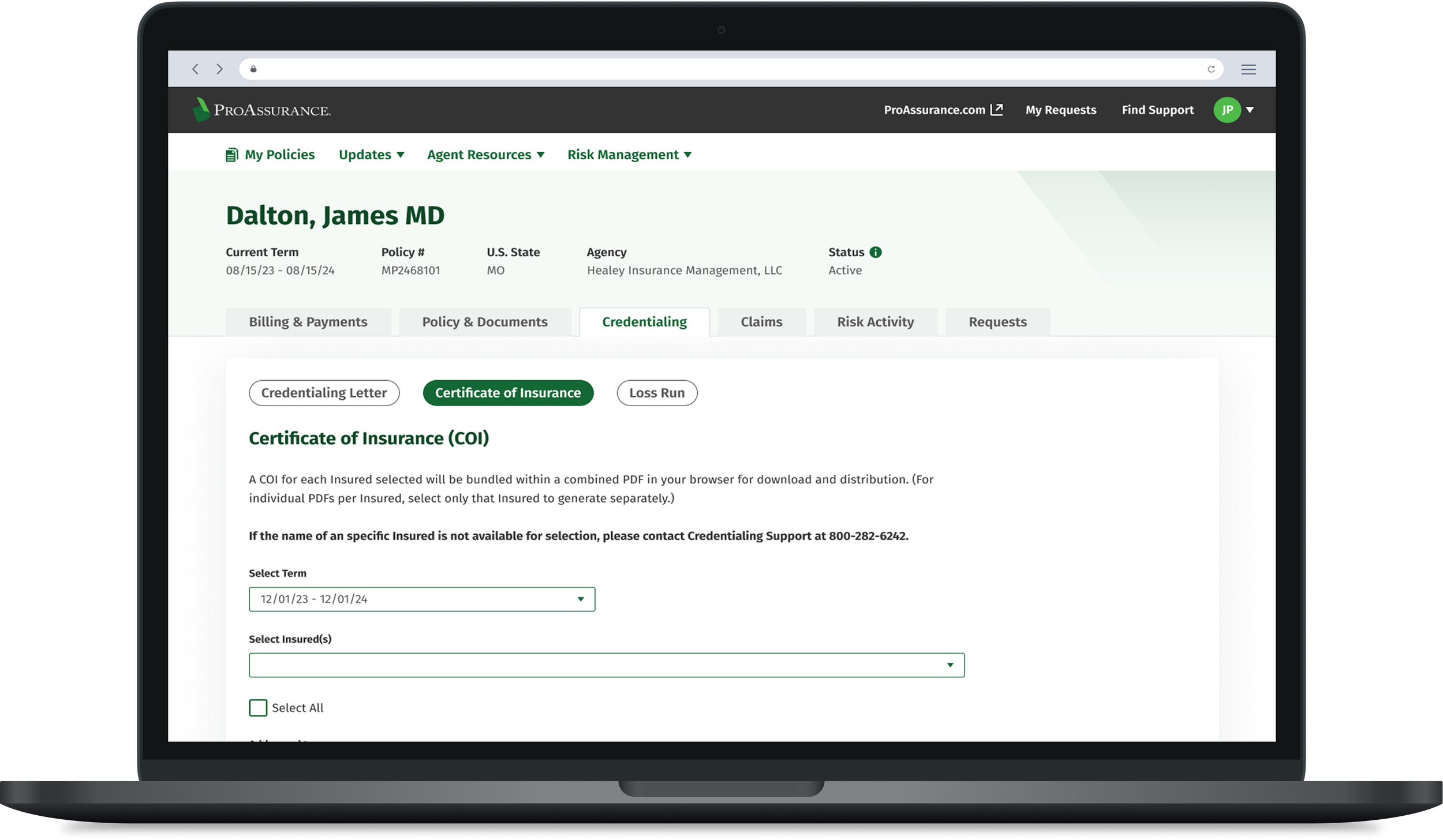
process snapshot
UX strategy

the tools

background
ProAssurance is a leading provider of medical professional liability insurance, supporting healthcare professionals through a network of agents and internal teams. Many administrative processes, like issuing certificates and credentialing letters, were previously handled manually, creating delays and a lack of transparency for users.
The modernization of ProAssurance’s enterprise portal created an opportunity to introduce self-service credentialing. Digitizing this workflow empowered users to complete requests independently, streamlined operations, and reduced reliance on manual intervention—laying the groundwork for future automation across other services.
context
As part of the enterprise portal’s modernization, the phase 1 rollout focused on migrating all existing services from the legacy system to the new platform — while also introducing key capabilities that had previously required manual handling by customer service or underwriting teams.
One such addition was Credentialing — a process that involved issuing official certificates and letters for policyholders.
The new platform offered an opportunity to automate this workflow, allowing users to log into their accounts and generate certificates on their own, with options to bundle multiple documents, issue on behalf of third parties, and track submissions in real time.
The Challenge
Before digitization, credentialing had no defined workflow.
Requests were processed manually, leading to two key problems:
Inefficient communication: Users had to contact their assigned underwriter by phone or email for every request.
Delays and back-and-forth: Missing or incomplete information often caused long processing times and user frustration.
The process
1. Discovery & Research
Partnered with the business analyst on the team to understand the existing manual process, compliance requirements, and backend system dependencies.
Mapped out end-to-end user touchpoints for each credentialing type to identify pain points and automation opportunities.
Created flowcharts capturing all possible use cases and user types — agents, underwriters, and administrators — to clarify ownership at each step.

2. Design Exploration
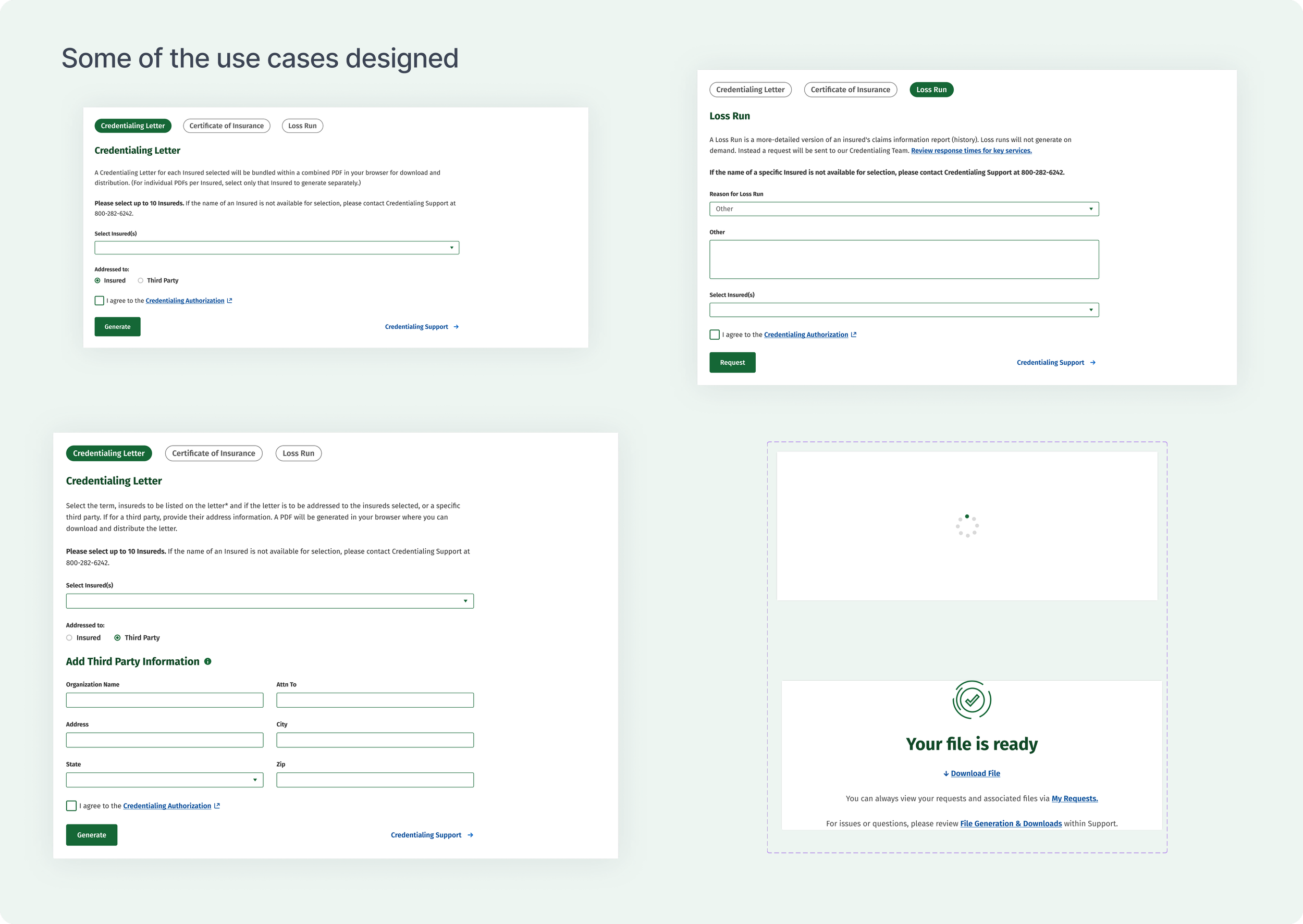
Designed low-fidelity prototypes for the three primary services under Credentialing:
Credentialing Letter
Certificate of Insurance (COI)
Loss Run
Explored layouts and interaction patterns that would allow users to complete each request independently while maintaining compliance.
3. User Testing
Conducted three rounds of usability testing with internal and external users representing each persona group.
Captured feedback around clarity, navigation, and data entry experience.
Iterated designs based on user feedback while aligning with business goals and regulatory requirements.
4. Collaboration with Developers
Worked closely with the development team to translate designs into implementable specs, ensuring visual and functional consistency within the platform’s component library.
Addressed platform limitations—for instance, an address form initially designed in three columns had to be adapted to the platform’s default one- or two-column layout.
Adjusted interaction patterns and field grouping to maintain usability despite these constraints.
5. Validation
Designs passed QA testing against functional and accessibility requirements.
The new self-service flow was well-received by stakeholders and users, reducing reliance on manual intervention.
Customer support calls dropped significantly, with remaining inquiries mostly related to users missing required details (e.g., policy information) rather than system issues.
the outcome
The introduction of the Credentialing tab transformed a manual, underwriter-dependent process into a fully self-service workflow.
Results included:
Significant reduction in task time for agents issuing certificates.
Increased satisfaction among users and internal teams due to transparency and ease of use.
Operational efficiency gains, freeing underwriting and customer service teams to focus on higher-value tasks.
The Credentialing rollout became a proof of concept for how manual services could be successfully digitized — setting the foundation for automating other workflows in future portal releases.
This case study represents a selection of work completed as Lead UX Designer on the ProAssurance Digital Experience Platform between 2022–2025. Most design elements cannot be shown, and business details have been modified or omitted to respect confidentiality. For an in-depth review, please contact me at sarahadi.work@gmail.com